TREND FORECAST
Shanghai Fashion Week SS27: Five key trends that redefine nostalgia, utility and underwear as outerwear
Shanghai Fashion Week SS27 gathers glimmers of Y2K nostalgia and a reimagined utility silhouette, merging European reverence with Chinese craft. Five trends—bloomers, cargo details, hip-focused volume, pastel romance, an
Shanghai Fashion Week SS27: Five key trends redefining the season
Overview: Shanghai Fashion Week SS27 demonstrates how Chinese design studios anchor global dialogue while imprinting local craft and cultural references. Rather than direct imitation, brands interpret European inspirations—Miu Miu, Prada, Chloé, and a nod to Jonathan Anderson’s Dior—but rethread them through Chinese materials, silhouettes, and textures. The result is a design language that speaks as homage, not replication, with a clear Y2K revival and a continued appetite for underwear-as-outerwear.
Why it matters for operators: For merchandising and retail teams, SS27 signals a revival of mixed references anchored in incremental novelty. The season favors expressive silhouettes, deliberate play with proportions, and a careful balance between utility and romance. Brands will need to calibrate product stories around five core pillars to drive accuracy in buying, assortment planning, and on-figure styling in stores and e-commerce.
The five trends below summarize the season’s architecture and the tactical implications for operators across brand, luxury and mass-market segments. Each trend blends nostalgia with contemporary function, offering options for product development, collaboration, and storefront storytelling.
"Underwear as outerwear remains the boldest signpost of SS27: lace trims, bralettes, slip dresses—styled as visible layers—are not just a trend but a merchandising proposition that stretches into accessories and outerwear."
The following sections unpack each trend with observed styling cues, emblematic silhouettes, and potential merchandising implications. The aim is to translate runway messaging into concrete retail strategies that fashion operators can adapt for product development, consumer targeting, and in-store experience.
KEY TAKEAWAY
Trend-led assortments must balance nostalgic references with contemporary wearability, ensuring materials, trims, and proportions translate into scalable product lines across categories.
Trend 1: Bloomers return with a couture twist
Bloomers, once relegated to undergarments, stepped into the spotlight with a refined, high-fashion sensibility. At Xiaoli and Xu Zhi, lace-edged shorts paired with broderie blouses and crochet tops evoke nostalgia without retreating to functional underwear. The silhouette favors gathered or ballooned hems that sit at or above the knee, producing a silhouette that readers as youthful yet sophisticated. The look is completed with delicate accessories—lace-up sandals and ankle boots—that amplify a playful, almost retro-feminine tone.
A sampling from Markgong pushes bloomers further toward irreverence: sheer turquoise bloomers with a feather hem paired with a plunging waistcoat and flat lace-up shoes. This combination reframes underwear as a curiosity rather than mere layering, signaling a market for statement pieces that can be styled across categories—from swim to outerwear to evening. For operators, bloomers offer a new bottom anchor that supports multi-season storytelling around texture and ornament, particularly for premium or avatar-driven brands.
Trend 2: Cargo details reclaimed with feminine nuance
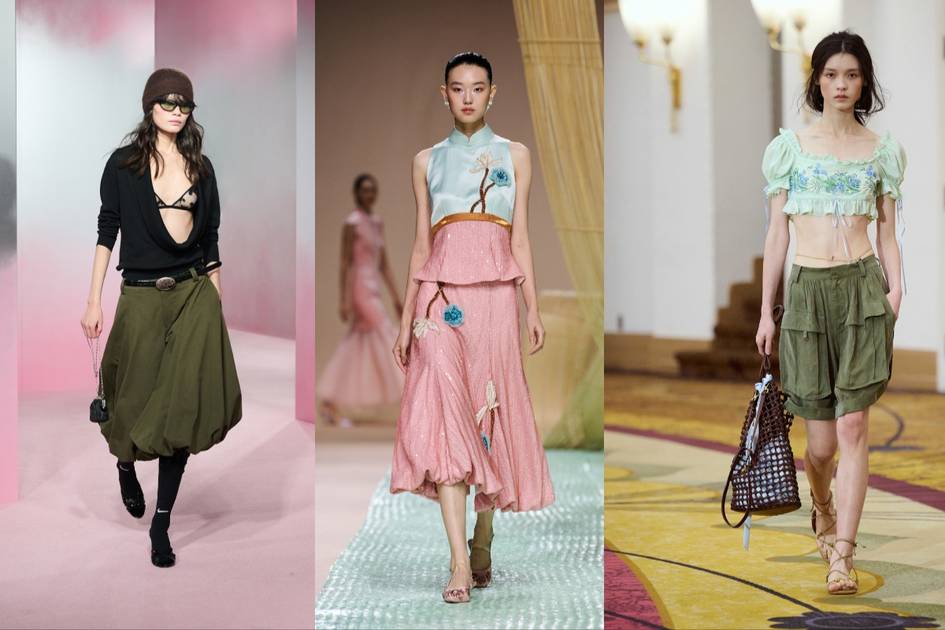
Cargo detailing, previously utilitarian, is reinterpreted with a romantic, couture mindset. Avvenn showcased a knee-length olive cargo skirt paired with a lace-trim camisole and glitter ballet flats, bridging workwear language with delicacy. Xu Zhi offered wide khaki cargo shorts styled with a mint puff-sleeve top featuring floral embroidery and ribbon ties. Such pairings signal that functional pockets and utility silhouettes can coexist with soft fabrics, pastel palettes, and intricate surface work.
Markgong’s bold cross-pollination—bright red Bermuda shorts with patch pockets under a pink double-breasted jacket, accented by a feather collar—takes cargo away from the stereotype of practicality into a bold fashion statement. For retailers, this suggests a tiered approach: core cargo pieces anchored by neutral tones, and high-visibility pieces that can serve as center-of-store accents or feature-story items in digital lookbooks.
Trend 3: Hip volume and silhouettes that push proportions
This season’s emphasis on hip-centric volume shifts the focal point away from the waist. Shushutong, Xu Zhi, and Markgong present variations of voluminous shapes—white miniskirts with flared hems, dresses with dropped waists, and broad-shouldered outerwear paired with swinging skirts. The visual emphasis on hips translates into merchandising opportunities: versatile tops that balance cropped or structured bottoms, and bottoms designed to be worn with elevated footwear for defined leg-lengthening effects.
Retail teams can leverage these silhouettes by creating mix-and-match guides that showcase belt placements, cropped knits, and high-heel or platform options to elongate frames. In store, test body-conscious display vignettes that highlight the hip-driven volume, paired with short hemlines to maximize perceived stature.
Trend 4: Pastel romance and traditional Chinese cues
Pastel tones—mint, sky blue, pink—dominate the palettes of Huamushen, Awaylee, and Markgong. The collections reference traditional Chinese cuts through mandarin collars and frog closures, with sequins, beadwork, and lotus-inspired embroidery lending sculptural dimension. Bubble-hem skirts and satin trousers introduce movement and lightness, aligning with a broader trend toward softness and daylight luxury. The juxtaposition of pastel gloss against traditional silhouettes creates a premium, culturally resonant narrative.
For operators, pastel-led assortments should be curated with cross-category coherence: tops with Mandarin collars that echo across daywear and elevated evening, coordinated with soft tailoring and lightweight tailoring fabrics. The lotus embroideries offer a luxury surface language that can anchor accessories and footwear capsules, enabling a multi-brand storytelling ecosystem in flagship spaces.
Bras as tops or visible lace accents persist as a central detail. Shao’s black underwired bra peeking from beneath open pinstripe waistcoats, and Markgong's exposed bra from behind a blazer, demonstrate a confident reframe of underwear as outerwear. This approach intersects with Y2K nostalgia and a modern insistence on at-once-sexy and wearable layering. Retailers should note that this requires careful merchandising: consistent styling language, supportive product narratives, and clear sizing and support messaging to avoid misinterpretation.
Operationally, visible underwear demands a nuanced shelf strategy: dedicated lingerie-as-outerwear capsules, co-branded elevate-lounge lines, and strategic cross-merchandising with outerwear and tailored pieces. Digital content should emphasize styling tips, ensuring consumers understand how to integrate these looks into daily wardrobes without compromising comfort or wearability.
Why this set matters for the broader fashion system: Shanghai Fashion Week SS27 demonstrates how global fashion dialogues are being absorbed and reinterpreted through a distinctly Chinese design lens. The five trends reveal a pattern: nostalgia-coded silhouettes reimagined with modern fabrics, trims, and craft techniques; a continued appetite for function-infused luxury; and a willingness to push boundaries on undergarment visibility as a normalized design feature. For investors, brand strategists, and retailers, this signals a shift toward product storytelling that blends heritage motifs with contemporary performance needs.
Key implications for the upcoming season include: anchoring assortments around five core pillars, integrating traditional Chinese craftsmanship with modern textiles, building cross-category editorial capsules, and aligning store environments to support bold, legible style narratives. The season also emphasizes that inspiration can be borrowed from international houses while guaranteeing a unique local voice—an approach that can safeguard brand differentiation in crowded markets.
- Develop five distinct capsule lines corresponding to bloomers, cargo details, hip-volume silhouettes, pastel-laden looks, and underwear-as-outerwear.
- Coordinate cross-category storytelling across ready-to-wear, lingerie-inspired outerwear, footwear, and accessories.
- Invest in surface embellishment capabilities (lace, beadwork, embroidery) that align with pastel palettes and traditional motifs.
- Craft marketing and in-store visuals that communicate the balance between nostalgia and contemporary function.
- Train styling teams to present bold silhouettes with confidence, including fit education for customers.